Table of Contents
ToggleLeague of Legends has exploded far beyond the Summoner’s Rift. What started as a competitive MOBA in 2009 has become a sprawling multimedia franchise, and the anime league of legends content is the crown jewel of that expansion. If you’ve been living under a rock, or just not touching Netflix, you’ve missed some genuinely phenomenal storytelling that even non-gamers are binge-watching. Arcane set the bar impossibly high, and now Riot is doubling down with spin-offs, expanding cinematic universes, and musical events that weave the game’s lore into animation that actually rivals big-budget studios. Whether you’re a hardcore player who knows every champion’s backstory or a casual viewer who just got sucked into the Piltover-Zaun drama, this guide breaks down everything the anime league of legends universe offers in 2026 and why it’s become unmissable viewing.
Key Takeaways
- Arcane set a new standard for video game adaptations by delivering emotionally compelling storytelling through high-quality animation that rivals major studios.
- The anime league of legends universe extends beyond Arcane to include spin-offs, cinematic shorts, and musical events like K/DA that all feed into a cohesive Runeterra lore.
- Riot Games intentionally made the anime the primary narrative canon, with game lore and champion mechanics now aligning to reflect how characters are portrayed in the animated series.
- Arcane’s success among both hardcore League players and anime enthusiasts proves that quality multimedia expansions can broaden a game’s audience far beyond its core player base.
- All anime league of legends content is available on Netflix for full series and episodes, while musical events and promotional clips are distributed through YouTube for wider accessibility.
- Future seasons will expand the anime league of legends universe beyond Piltover and Zaun into other regions like the Freljord, Demacia, and Noxus, with confirmed projects like Arcane: Bridger filling narrative gaps.
What Is the League of Legends Anime Universe?
The League of Legends anime universe isn’t just Arcane. It’s an interconnected web of animated shows, cinematic events, and storytelling projects that expand the lore of Runeterra, the world where the game takes place. Riot Games made a deliberate shift away from treating the game as the primary canon. Instead, they’ve built a multimedia ecosystem where the anime, cinematics, and game lore all feed into each other.
Think of it like Marvel, but for a fantasy MOBA. The anime league of legends initiatives include flagship series like Arcane, shorter episodic shows like Legends: Arcane, musical animated events tied to K/DA and other music groups, and cinematic shorts that explore specific champions or regions. The scale is massive: we’re talking dozens of characters, multiple continents across Runeterra, and storylines that span years of in-game narrative.
What makes this universe compelling is consistency. Riot hired actual lore writers, visual directors, and showrunners who understand both the game and animation. They’re not just slapping champion skins on a generic anime framework. Each project, whether it’s a full season or a 15-minute short, contributes to a larger tapestry. A champion’s story in the anime might explain their mechanics in-game, or a seasonal event might lead directly into game lore updates. That integration keeps players invested.
Arcane: The Groundbreaking Series That Started It All
Arcane premiered in November 2021 and changed the conversation about video game adaptations overnight. Before Arcane, “video game anime” usually meant serviceable at best, forgettable at worst. Arcane broke that curse so thoroughly that it’s now the reference point for how game-to-screen adaptations should work.
The show focuses on the conflict between Piltover, a wealthy, technologically advanced city-state, and Zaun, a polluted undercity struggling under Piltover’s oppression. It’s structured around two core characters: Vi and Powder (who becomes Jinx), sisters caught on opposite sides of an expanding war. The tragedy of their relationship drives the entire narrative. That focus keeps the story grounded even when the world-building gets intricate.
Arcane was developed by Christian Linke and Alex Yee for Netflix, with Riot Games providing lore and creative oversight. The animation studio Fortiche Productions brought the visual style to life, a blend of 3D and 2D animation with an art-deco influence that makes every frame look intentionally composed. The show’s animation is arguably its biggest strength. Character expressions convey pages of subtext, and fight choreography feels weighty and consequential.
Season 1: Establishing the Piltover and Zaun Conflict
Season 1 consists of nine episodes split into three acts, each escalating the tension and shifting perspective. The first act introduces Vi as an idealistic kid in Zaun and establishes why her life is about to explode. We meet her parents, her sister Powder, and the world they inhabit.
Then everything burns down.
Without spoiling specifics, an event at the end of Act 1 fractures Vi and Powder’s lives irreversibly. Powder isn’t equipped to handle the consequences, and her choice to use hextech technology (Runeterra’s magical science) creates the inciting incident for the entire series. This is where the show earns its emotional weight. It doesn’t feel melodramatic because the consequences are earned through character logic, not plot convenience.
Acts 2 and 3 track how Vi and Powder diverge. Vi ends up in Piltover’s underbelly, training under a crime boss named Vander (actually a massively important character, more important than the game itself acknowledges). Powder, abandoned and traumatized, becomes obsessed with hextech power. She gets taken in by Silco, Zaun’s most dangerous criminal, and begins her transformation into Jinx.
The genius of Season 1 is that it’s a character story first, lore-building second. The hextech conflict, the regional politics, the champion introductions, all of that serves the core narrative about two sisters being pulled apart. By the end of Season 1, viewers care deeply about Vi and Jinx’s fates, and they understand why the other champions (like Jayce, Caitlyn, Heimerdinger, and Viktor) matter to their story.
Season 2: Expansion and Global Lore
Season 2 dropped in November 2024 and immediately expanded the scope. Where Season 1 was intimate, two cities, one core conflict, Season 2 brings in new regions, new champions, and the looming threat of something much larger than Piltover and Zaun.
Season 2 is where Riot started threading connections to the broader League universe. New characters like Caitlyn (yes, the champion) get proper development, and the hextech technology’s implications become cosmic in scale. The season introduces the concept of Arcane magic, not just magical science, but something older and more dangerous lurking beneath Runeterra’s surface.
This season also airs in acts, and each act ends on massive cliffhangers. The writing tightens compared to Season 1, with fewer characters but deeper focus. The animation quality leaps forward, fight scenes are more inventive, environmental storytelling becomes richer, and some sequences are genuinely breathtaking.
By the end of Season 2, the setup for future seasons becomes clear. Riot has confirmed that Arcane will continue, but the scope will shift from Piltover and Zaun to the larger world of Runeterra. Future seasons might explore the Freljord, Demacia, or Noxus, all regions with their own champion rosters and conflicts.
Upcoming Arcane Projects and Spin-Offs
Riot Games has made it clear that Arcane is the flagship, but they’re not content to limit the anime league of legends universe to one show. Several spin-off projects are in development or confirmed for the coming years.
Arcane: Bridger is a confirmed project focusing on the events between seasons. It’s designed to fill narrative gaps and explore side characters who didn’t get enough screen time in the main series. These bridging stories will likely tie directly into the next major arc.
Riot has also hinted at regional deep-dives, standalone anime projects exploring places like Noxus, Demacia, and the Freljord. These won’t necessarily be as long as Arcane, but they’re positioned as equally high-quality productions. The Freljord, in particular, has rich lore around champions like Ashe, Sejuani, and Anivia that deserves animated treatment.
What’s interesting is that Riot is thinking long-term. Instead of rushing spin-offs to cash in on Arcane’s success, they’re being selective. Each new project has to justify itself narratively, it’s not just “put a popular champion in a show.” That approach has already paid dividends. The reception to Arcane proved that gamers and anime fans will watch quality content tied to the game, even if they’re not invested in League as a multiplayer experience.
These projects will likely release on Netflix, maintaining the deal Riot established with the streaming giant. Netflix gets exclusive distribution, and Riot maintains creative control, a rare arrangement in game-to-screen adaptations.
Other League of Legends Animated Content and Shows
Arcane might be the headliner, but it’s not the only anime league of legends content. Riot has been building the animated universe through other channels, each with a different tone and narrative focus.
Legends Animated Series and Cinematic Universe
Legends: Arcane (not to be confused with the main Arcane series) is a collection of animated shorts exploring individual champions and their backstories. These 15-30 minute episodes focus on characters who appear in Arcane but don’t get deep development, plus champions entirely outside the Piltover-Zaun narrative.
Episodes have covered:
- Heimerdinger’s journey to Piltover and his role in hextech’s development
- Viktor’s transformation and his obsession with perfection
- Jayce’s rise to political prominence
- Caitlyn’s family legacy and her entry into enforcement
These shorts assume viewers have watched Arcane, so they build on that foundation rather than starting fresh. The animation quality is consistent with the main series, Fortiche Productions handles all of it, and the writing fills gaps that the main narrative couldn’t address.
Beyond Legends, Riot releases cinematic trailers for each season and major event. These aren’t anime in the traditional sense, but they’re animated and tie into lore. K/DA cinematic, for example, is a music video featuring K/DA champions in a stylized, high-budget animation. These cinematics have become expected viewing for hardcore fans and drive narrative progression between seasons.
K/DA and Musical Animated Events
K/DA is Riot’s answer to the question: “What if League of Legends had a virtual J-pop group?” The concept is that several champions form a band, Ahri, Akali, Evelynn, and Kai’Sa initially, with other champions joining for different eras.
Each K/DA era comes with animated music videos, often directed by different studios to create visual variety. The first K/DA cinematic (“Pop/Stars”) became a cultural moment, reaching over 200 million YouTube views. The videos are high-concept: think Hype Train meets League of Legends. The animation style shifts from series to series, but each maintains the quality bar Arcane set.
In 2024, K/DA released “Supermodel” and “Villain” as part of their latest era, both with accompanying animated content. These videos don’t advance Arcane’s plot, but they expand the universe by showing different facets of Runeterra, high-tech cityscapes, underground clubs, neon-drenched locations that feel like they exist in the same world.
Other music-driven animated events include collaborations with artists like Bea Miller and Sting, who’ve created original music for League champions. These projects range from short animatics to full music videos, each adding texture to the anime league of legends ecosystem.
The genius of these musical projects is that they don’t require game knowledge. A viewer can watch a K/DA video without understanding League’s mechanics and still be entertained. That broadens the audience significantly, introducing new people to the universe who might eventually check out Arcane or the game itself.
How the Anime Connects to League of Legends Lore
The relationship between the anime league of legends and the game’s lore is intentional and reciprocal. This isn’t a situation where the show contradicts the game or exists in a separate timeline. Instead, the anime is the primary lore canon, and the game is catching up.
When Riot revamped their lore approach, they decided that animated media would take narrative priority. Champions’ backstories are updated to align with how they’re portrayed in Arcane and other shows. For example, Jayce’s character in the show influenced how his lore was rewritten in-game. Viktor the machine herald has been significantly recontextualized based on his Arcane portrayal.
This creates a feedback loop. Players who watched Arcane now understand why certain champions have specific relationships in-game. Jinx and Vi obviously have history together, but in-game that’s just flavor text. In the anime, it’s the emotional core of the entire series. Similarly, Caitlyn and Vi have a complicated dynamic in Arcane that complicates their in-game relationship.
Character Development and Story Arcs
Characters in the anime league of legends universe undergo arcs that continue beyond what we see on screen. Ekko, for example, is a supporting character in Arcane Act 1 and grows into a more prominent role as the series progresses. His invention of the Firelight and his street-level organization has direct parallels to his in-game abilities and playstyle.
Powder/Jinx is the most obvious example. The anime shows her psychological breaking point and how hextech becomes her coping mechanism. In-game, her abilities (grenades, rockets, minigun) represent the chaotic magic she learned to weaponize. Her dialogue and voice lines in-game reference events from Arcane. This integration makes her feel like a complete character with history, not just a champion with a kit.
Even champions who briefly appear in Arcane benefit from this treatment. Heimerdinger, Viktor, and Jayce all get expanded characterization in the anime that informs how players should think about them. The anime shows why these characters matter to the world, not just mechanically in the game but as influential figures in Runeterra’s political and magical landscape.
World Building and Regional Storytelling
Runeterra is massive. The game has champions from Bilgewater, the Shadow Isles, Noxus, Demacia, Ionia, the Freljord, and more. Arcane focuses almost exclusively on Piltover and Zaun, but it establishes the visual language for how other regions should feel.
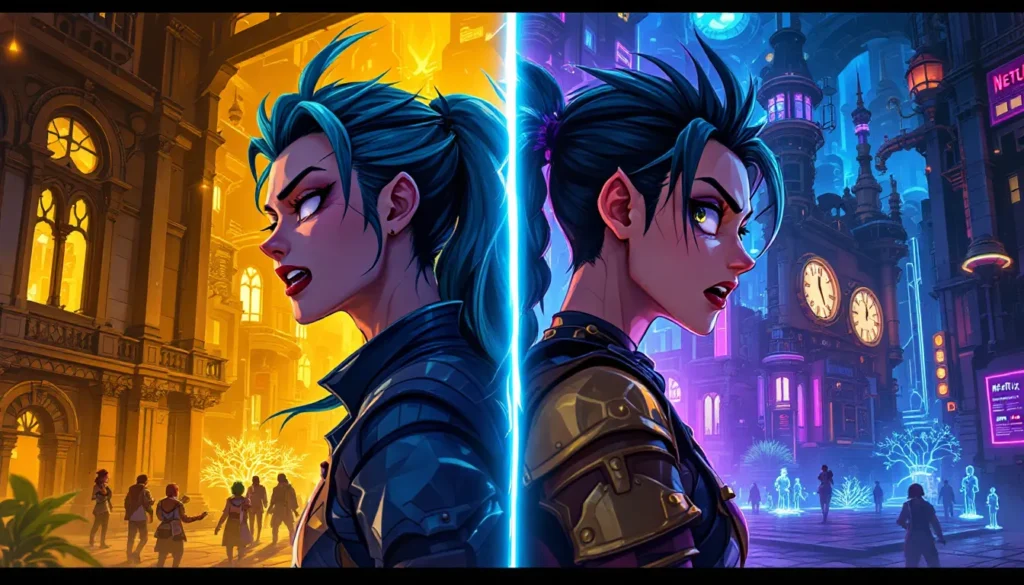
Piltover is steampunk-influenced, with clockwork architecture and gas lamps. Zaun is grimy and industrial, with rusted metal and bioluminescent magic. Future anime projects will likely follow this visual framework while introducing the aesthetics of other regions.
Riot has also established that the anime timeline ties directly to in-game events. The Arcane War that happens in the show contextualizes seasonal events and champion releases in the game. When Riot releases a new champion, they’ve started providing animated shorts or cinematics explaining where that champion comes from and how they fit into the timeline.
This world-building approach gives the anime league of legends universe legitimacy. It’s not separate from the game’s world, it’s the definitive version of it. Players who want to understand Runeterra’s lore deeply should watch the anime. Casual gamers can ignore it and still play, but they’re missing out on the richer narrative experience.
Why League of Legends Anime Has Resonated With Gamers and Anime Fans
The anime league of legends content has resonated across two audiences that don’t always overlap: hardcore League players and anime enthusiasts. The success of Arcane in particular proved that games could reach beyond their built-in fanbase if the quality was there.
Part of that success is pure craft. Riot and Fortiche didn’t cut corners. But another part is that the anime taps into emotional storytelling that the game itself can’t fully deliver. A League match is 30-40 minutes of mechanical gameplay. You can’t pause for character introspection in a ranked game. The anime gives those characters space to breathe.
Visual Style and Animation Quality
The visual identity of Arcane and the broader anime league of legends universe is instantly recognizable. Fortiche Productions uses a hybrid 2D/3D animation style that feels fresh compared to typical anime or Western animation. Characters move with weight and intention. Environments are detailed enough to feel lived-in but stylized enough to avoid uncanny valley territory.
What sets the animation apart is the attention to micro-expressions. A character’s eyes might betray doubt even as their words express confidence. Jinx’s unstable grin conveys her psychological state without excessive exposition. Vi’s hardened demeanor masks pain that occasionally cracks through. That level of character animation sophistication elevates the storytelling.
The color palette also deserves mention. Act 1 of Arcane uses warmer, golden tones in Zaun to establish the community and warmth of Vi’s early life. Act 2 introduces cooler tones as the tragedy sets in. By Act 3, the color grading is almost desaturated, reflecting the emotional bleakness of the conflict. This isn’t subtle, it’s deliberately chosen to reinforce the narrative mood.
Anime fans who typically watch series like Attack on Titan or Demon Slayer immediately recognized that Arcane was operating at that production level. The animation quality removed the stigma of “game adaptation” that might have prevented viewers from taking it seriously.
Compelling Narrative and Emotional Impact
At its core, Arcane is a tragedy structured around betrayal, desperation, and the consequences of choices made under pressure. Vi makes a choice in Act 1 that sets Powder on her path to becoming Jinx. Powder makes a choice in Act 2 that affects everyone around her. By Act 3, the question isn’t whether their relationship can survive, it’s whether they can even recognize each other as the same people.
This emotional arc works because the anime takes time to establish what’s at stake. We see Vi and Powder as kids, playing together, laughing. That foundation makes their separation gut-wrenching. The show doesn’t manipulate you into caring, it earns it.
The supporting characters enhance this emotional core. Vander becomes a father figure that viewers desperately want to see succeed. Caitlyn starts as antagonistic but becomes sympathetic as her worldview challenges. Jayce seems noble until his ambitions cloud his judgment. These aren’t flat characters: they’re fully realized people making difficult decisions.
The pacing also contributes to the emotional impact. Each act reveals new information that recontextualizes previous scenes. A moment that seemed noble in Act 1 might feel tragic in Act 3 when you understand the full context. That structure rewards re-watching and keeps discussions active in fan communities.
For esports enthusiasts following LoL Esports competitive play, Arcane adds a layer to champion appreciation. Watching Jinx play in professional matches hits differently after seeing her origin story. The same applies to other characters who appear in competitive rosters, understanding their lore creates a deeper connection to the competitive scene.
Gamers who engage with building strategy and champion mechanics also find that the anime contextualizes why certain champions have the abilities they do. Knowing Jinx’s backstory with hextech enhances appreciation for her grenade and rocket mechanics. Understanding Viktor’s obsession with perfection explains why his upgrades focus on mechanical enhancement.
Where to Watch League of Legends Anime
The anime league of legends content is primarily distributed through Netflix, which secured an exclusive deal with Riot Games for Arcane. That means all episodes of Arcane Seasons 1 and 2 are available on Netflix globally (in most regions: some countries have limited availability).
Arcane Season 1 consists of 9 episodes, released weekly starting in November 2021. The show’s structure of releasing in three acts meant viewers got three episodes at a time, then wait periods between acts. Arcane Season 2 follows a similar pattern with multiple episodes released at once.
The Legends: Arcane shorts are available on Netflix as well, organized as a separate “season” or special. These are essential viewing for anyone who finished Arcane and wants more, they provide context that enhances re-watches of the main series.
K/DA and other musical animated content is primarily distributed through YouTube, both on Riot’s official channels and on the K/DA band’s official accounts. These videos are free to watch, making them more accessible to casual viewers.
For esports fans wanting to stay current, Dot Esports regularly covers new anime releases and their impact on the competitive League scene. Coverage includes deep dives into how anime canon affects champion meta understanding.
Netflix also includes “Arcane: Cuervos” (a bonus short exploring some side characters) and occasional behind-the-scenes documentaries about the making of Arcane. These bonus features provide production insight that anime enthusiasts and game developers both appreciate.
Riot occasionally releases anime league of legends content on other platforms for promotional purposes, clips on TikTok, highlights on YouTube, etc., but Netflix remains the exclusive home for full episodes and series. This exclusivity actually benefits viewers, as it meant Riot could guarantee consistent funding and creative control without studio interference.
Availability may shift in future years as new seasons release and streaming deals potentially change, but as of 2026, Netflix is where you go for Arcane and related series content.
Conclusion
The anime league of legends universe has become something that transcends the game itself. What started as Arcane, a high-risk, high-reward bet that Riot Games could make a quality television show, has evolved into a full multimedia ecosystem that rivals established franchises. The storytelling is sophisticated, the animation is world-class, and the emotional impact is genuine.
If you’re a League player, the anime deepens your connection to champions you use regularly. If you’re an anime fan, Arcane and related projects offer storytelling that stands up to anything being produced in the anime space. And if you’re neither, you’ll still be entertained by a well-crafted narrative about two sisters caught in a widening conflict.
Future seasons will expand beyond Piltover and Zaun, exploring other regions and characters. Those spin-offs have massive shoes to fill, but Riot’s commitment to quality over quantity suggests they’ll meet that challenge. The anime league of legends universe isn’t slowing down, it’s accelerating.
The combination of strong character work, thematic depth, and visual craftsmanship makes the League of Legends anime essential viewing for gamers and non-gamers alike. Whether you’re diving in fresh or returning for Season 2 after a multi-year break, there’s never been a better time to enter Runeterra’s animated world. The barrier to entry is low (Netflix subscription), but the emotional payoff is substantial. That’s the formula that’s made Arcane a cultural moment and positioned League as a franchise that can compete in prestige storytelling across any medium.